

Structured Cabling & Network Wiring Installation in Washington DC, Maryland & Virginia
A single bad cable run can knock an entire floor offline. When your network slows to a crawl or a VoIP call drops mid-sentence, productivity bleeds money by the hour. BytesNCables is the only DMV contractor combining BICSI cabling credentials, Verkada camera certification, and Brivo access control under one roof. We install TIA-568 compliant cabling systems built for 10 Gbps and beyond, with every single run Fluke-certified before handoff.
 Get Your Free Site Survey





How We Install Your Cabling System
Step 1
Free Site Survey
We walk your building, map cable pathways, count drops, and identify MDF/IDF locations. You get a written scope with line-item pricing within 48 hours.
Step 2
Design & Plan
Our team selects the right cable category (Cat6 or Cat6A), plans riser vs. plenum runs, and coordinates scheduling with your GC or building management.
Step 3
Install & Terminate
BICSI-trained crews pull cable, terminate at patch panels and wall plates, dress racks, and label every port per TIA-606 standards.
Step 4
Test & Certify
Every run gets Fluke-tested. You receive a PDF certification report for each link, confirming TIA-568 compliance and supporting manufacturer warranty claims.

Free Survey. Real Pricing. No Surprises.
Every project starts with a free wireless site survey. You receive an itemized quote before any work begins. No hidden fees. No vague estimates.
Our Structured Cabling & Data Cabling Services
BytesNCables provides seven core structured cabling services across Washington DC, Maryland, and Virginia: Cat6/Cat6A installation, fiber optic splicing, new construction cabling, patch panel termination, cable management, office network drops, and full-scope low voltage contracting. Every job is Fluke-certified and documented.
Cat6 & Ethernet Cable Installation
Slow file transfers and buffering video calls usually trace back to aging Cat5e or poorly terminated cables. We install Cat6 (1 Gbps) and Cat6A (10 Gbps at full 100-meter distance) to TIA-568 specs, with every run Fluke-tested before we hand over the certification report.
Fiber Optic Installation & Splicing
Copper can't reach between buildings or across a campus. Our techs fusion-splice multimode OM3/OM4 fiber for in-building backbone runs and single-mode fiber for long-haul connections. Each strand is OTDR-tested and documented.
Fiber Optic Installation & Splicing
Getting cabling right during the build saves tens of thousands later. We coordinate with GCs and electricians to pull cable before drywall goes up, using plenum-rated cable in air-handling spaces and riser-rated cable for vertical runs between floors, per NEC 2026 requirements.
Patch Panel & Cable Termination
Tangled patch cables in the MDF closet? That mess creates crosstalk, makes troubleshooting a nightmare, and violates TIA-606 labeling standards. We terminate to 568B, dress cables on proper cable management panels, and label every port so your IT team can trace any connection in seconds.
Cable Management & Server Rack Organization
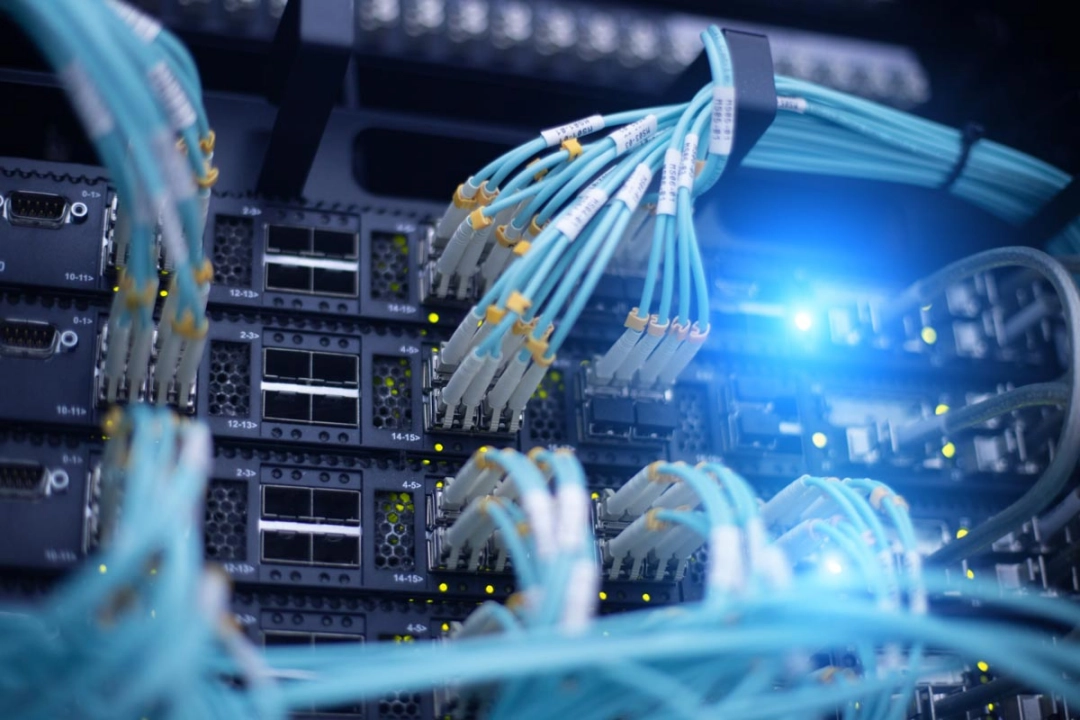
An overloaded rack with cables zip-tied into a rat's nest blocks airflow and hides failing connections. We redesign rack layouts, install horizontal and vertical cable managers, and route patch cords so you can swap a switch without disturbing 40 other connections.
Office Network Drops & Wiring
Need 2 drops per desk or 200 across a new floor? We handle both. Each run terminates at a flush-mounted wall plate on one end and a labeled patch panel port on the other. PoE-capable drops (802.3af/at/bt) feed your IP phones, wireless APs, and security cameras over the same cable.
Low Voltage Contractor Services
Fire alarm circuits, intercom wiring, AV cabling for conference rooms. Not every low voltage job is data. Our team handles the full low voltage scope so you deal with one contractor, one schedule, and one point of accountability across your DC, Maryland, or Virginia project.
Common Structured Cabling Questions
What is the difference between Cat6 and Cat6A for business?
Cat6 supports 1 Gbps and can push 10 Gbps only up to 55 meters. Cat6A delivers 10 Gbps at the full 100-meter TIA-568 distance, handles PoE heat better, and supports Wi-Fi 6E/7 backhaul. For any new office buildout in DC, MD, or VA, we recommend Cat6A. The cable costs about 9% more than Cat6, but re-pulling cable through finished walls later costs far more than the upfront difference. Call us at (202) 295-7180 and we can walk through the specs for your specific floor plan.
How much does commercial structured cabling cost per drop?
Most commercial Cat6 drops in the DC metro area run $150 to $250 per drop, fully installed and tested. Cat6A drops typically fall between $200 and $350 depending on ceiling type, cable run length, and building access. A 50-drop office project might total $10,000 to $15,000 including patch panels and rack buildout. We provide detailed line-item quotes after a free site survey. No ballpark surprises. Call (202) 295-7180 to schedule yours.
How long does a commercial cabling installation take?
A typical 30 to 50 drop office buildout takes 3 to 5 business days from cable pull to final Fluke certification. Larger projects, like a 200+ drop multi-floor installation, may run 2 to 4 weeks depending on the building’s layout and coordination with other trades. New construction projects where walls are still open move faster. Retrofits in occupied offices take longer because we work around your team. Contact us at info@bytesncables.com for a project timeline estimate.
Do I need Cat6A or is Cat6 enough for my office?
If your office runs basic web browsing, email, and VoIP on fewer than 30 desks, Cat6 handles the load today. But here is the catch: cable stays in the wall for 10 to 15 years, and bandwidth demand doubles roughly every two years. Any building adding Verkada cameras, wireless APs, or PoE lighting should go Cat6A from the start. The performance jump from 1 Gbps to 10 Gbps is not a minor upgrade. Need help deciding? Call (202) 295-7180 and we will evaluate your current and projected traffic.
What is cable testing and certification for network wiring?
Cable certification means running every installed cable through a Fluke DSX CableAnalyzer (or equivalent Level VI tester) to verify it meets TIA-568 performance parameters: wire map, length, insertion loss, NEXT, and return loss. A passing result generates a PDF certification report for each link. This report is your proof that the installation meets manufacturer warranty requirements and industry standards. We certify every single run we install across DC, Maryland, and Virginia. Call us at (202) 295-7180 to learn about our testing process.
How many network drops do I need per workstation?
BICSI‘s Telecommunications Distribution Methods Manual recommends a minimum of 2 drops per workstation: one for data and one for voice or a secondary device. In practice, we install 2 to 3 drops per workspace for most DC metro offices because IP phones, docking stations, and dedicated connections for printers or wireless APs all need their own port. Planning extra drops now costs a fraction of adding them after the walls are finished. Email us for a drop count worksheet based on your floor plan.
Why hire a BICSI certified cabling installer?
BICSI certification means the installer passed hands-on and written exams covering TIA standards, cable termination techniques, testing procedures, and safety protocols. An uncertified installer might get the cable from point A to point B, but poor termination, incorrect bend radius, or missing fire-stop can cause intermittent failures that are expensive to diagnose. Our BICSI-trained crews follow TDMM guidelines on every job. That matters when you need a 25-year manufacturer warranty on your cabling plant. Ready to work with certified installers? Call (202) 295-7180.
Still have questions?
Your Network Problems Start at the Cable. Let Us Fix It. Call us on
+1-202-486-0962
Leave your details, and one of our network specialists will call you back
Tell us about your project and a cabling specialist will call you back within 4 business hours. No sales reps, no generic quotes. You speak directly with the crew that does the work.